Is Piedmont French Or Italian?
Piedmont is firmly Italian, but its name, its royal history and its table all carry a French accent. Here is where the confusion comes from and what is actually true.
 By Chiara Barbero, Piedmont Bike Tour Guide and Langhe Cycling Specialist
Is Piedmont French Or Italian?
Piedmont is Italian. It is one of Italy's twenty regions, its capital is Turin, and it has been part of the Italian state since unification in the nineteenth century, when Turin served as the first capital of the new kingdom. The confusion is understandable though: the name is French in form, the House of Savoy ruled across the Alps, and the cooking borrows openly from French technique.
That short answer rarely satisfies anyone, because the question is really three questions wearing one coat. Is the name French? Was the region ever French? And why does a plate of vitello tonnato or a Barolo label feel so different from what people expect of Italy? Each of those has a different answer, and only the first is a simple yes.
The name itself is the easy part. Piemonte literally means "at the foot of the mountains," a plain geographic description of a region wedged at the base of the Alps. English borrowed the word through French, which is why it looks French to an English speaker, but Italians use the same construction: pie de mont, foot of mountain. The French-sounding name is a translation artifact, not a political statement.
The deeper story involves a dynasty that spent centuries with one foot on each side of the Alps, a wine culture that learned from and then outgrew its French models, and a kitchen that absorbed French methods during the years when French was the language of European courts. None of that makes Piedmont French. All of it makes Piedmont the most French-flavored corner of Italy, which is a different and better thing.
If the question has brought you here while planning a trip, the practical version is simple: you will hear Italian, you will spend euros, you will eat Italian food cooked with French care, and you will be riding through a UNESCO World Heritage landscape inscribed in 2014 for its vineyard culture. The tours below are a good way to taste that blend in a single day.
Was Piedmont Ever Ruled By France?
The House of Savoy ruled Piedmont for centuries and held lands on both the Italian and French sides of the Alps, at times with the dynasty's heartland in what is now French-speaking territory. The kingdom they built, with Turin as its capital, became the driving force behind Italian unification, so Piedmont's rulers were never simply Italian, but the state they created most definitely was.
This is the historical knot at the center of the question. The Savoy family emerged in the medieval county of Savoy, territory that today sits mostly inside France. Over centuries they shifted their center of gravity eastward, and by the early modern period Turin was their capital. A French-speaking court, an Italian-speaking population, and a dynasty that owned pieces of both worlds: that is the recipe for a region that reads differently from Tuscany or Sicily.
French influence ran through the aristocracy's table as much as its politics. Court cooks trained in French methods, and the habit stuck. It is one reason Piedmontese cooking shows sauces and preparations that feel closer to Lyon than to Naples, while remaining built entirely on local ingredients: the hazelnuts, the white truffle, the beef of the Langhe hills.
But the direction of travel matters. Piedmont did not drift toward France. The Kingdom of Sardinia, as the Savoy state was known, was the state that engineered Italian unification, and its prime minister, Count Camillo Benso di Cavour, was a Piedmontese noble from Turin. When Italy became a single country in the nineteenth century, it did so under a Piedmontese crown, with Turin as the first capital before the seat of government moved to Florence and then Rome.
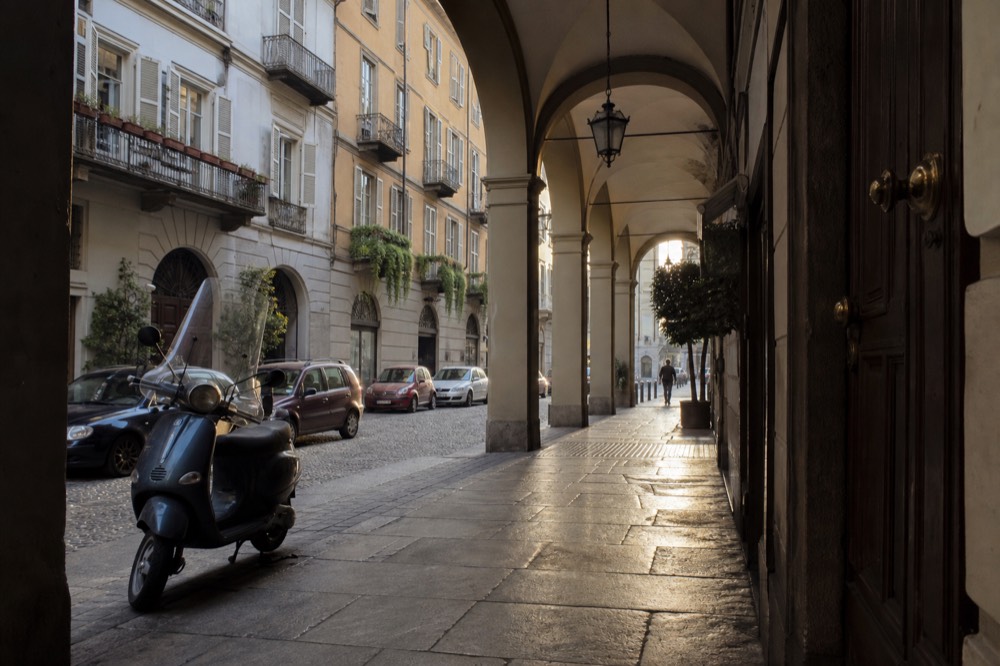
The landscape itself carries the same double signature. The Langhe hills south of Turin roll gently like Burgundy's, and the wine villages, Barolo with 613 residents, La Morra at 508 metres above sea level, Serralunga d'Alba with its medieval castle tower, look more like French hilltop hamlets than like Italian hill towns. Yet the vineyards behind them produce Nebbiolo, a grape that exists nowhere in France and makes Barolo, a wine aged a minimum of 38 months, 18 of them in wood, under rules written in Italian law.
If that blend of French-looking villages and unmistakably Italian cellars sounds like your kind of day, the food-and-wine rides around Asti are the easiest way to taste it firsthand, and the live listings carry the current dates and availability.
There is a useful comparison table hiding in all this:
| Question | Short answer | The nuance |
|---|---|---|
| Is the name French? | No, but English borrowed it through French | Piemonte means "foot of the mountains" in Italian |
| Was Piedmont politically French? | No | The Savoy dynasty held lands in both countries but ruled from Turin |
| Is the food French? | No, but French technique shaped it | Court cooking left a mark on sauces and service |
| Are the wines French? | No | Nebbiolo, Barbera and Moscato are native grapes under Italian DOCG law |
| Do they speak French? | No | Italian is the language; local dialects carry older influences |
Do People In Piedmont Speak French?
No. Italian is the language of Piedmont, spoken universally in towns, shops, restaurants and on every tour listing in the region. What confuses visitors is that Piedmontese dialects, and the minority languages of the western Alpine valleys, belong to linguistic families that also produced French, so occasional words and place names sound French without being French.
The UNESCO citation for the vineyard landscape actually captures this layered history better than most guidebooks. In its description of the property, inscribed in 2014 under cultural criteria (iii) and (v), the World Heritage Committee notes that vine pollen has been found in the area dating from the 5th century BC, when Piedmont was a place of contact and trade between the Etruscans and the Celts, and that Etruscan and Celtic words, particularly wine-related ones, survive in the local dialect. That is the region in one sentence: a crossroads whose language keeps souvenirs of everyone who passed through.
So the sounds that strike a visitor as French are usually older than France's current borders. Place names ending in -asca and -asca-style Celtic elements, dialect words for tools and foods, and the Occitan-inflected speech of some western valleys all point to a shared Alpine substrate rather than to French political ownership. You will not need a word of French on any visit.
English is more useful than French in the wine villages these days, and even that is optional on a guided tour. The Langhe, Roero and Monferrato recorded 761,274 arrivals and over 1.7 million overnight stays in 2025, with foreign guests making up 61 percent of overnight stays, led by Switzerland, Germany, the Netherlands, France and the USA. Cellar doors are used to international visitors, and tour operators run in several languages.
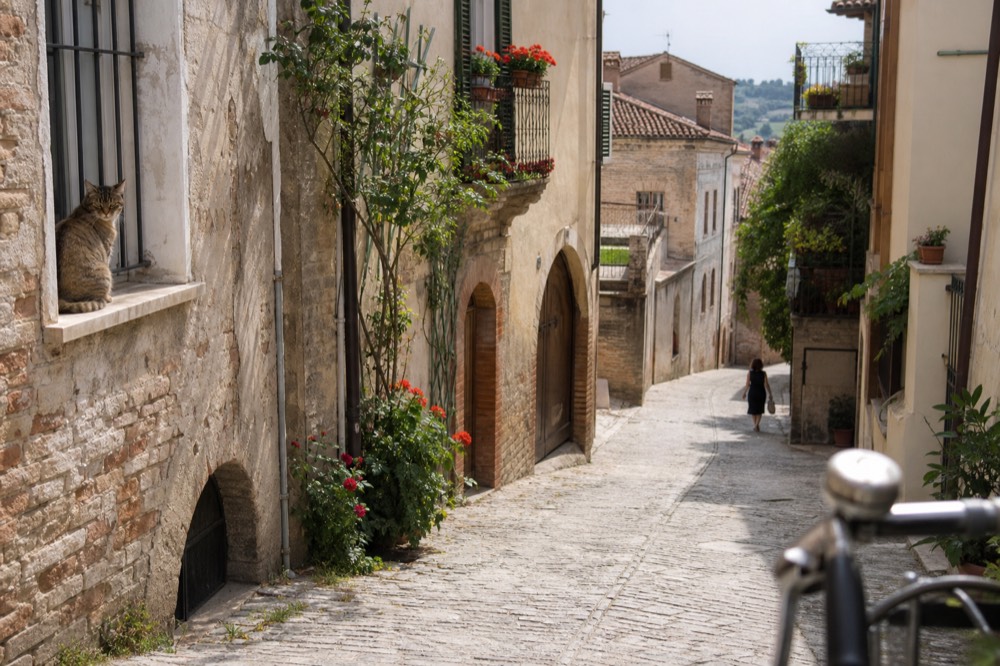
For cyclists, the language question matters less than the road signs, and those are straightforwardly Italian. The practical rules of riding here are Italian law too: there is no helmet requirement at any age, but a reflective vest is mandatory outside built-up areas after dark and in tunnels, and a bell is legally required equipment on every bicycle. Those three facts, from the Italian highway code, matter more on a Langhe holiday than any linguistic history.
The Asti culinary cycling tour is a good example of how the language and the table come together. It runs about 4 hours through the Asti countryside with food and wine tastings built in, from $186 per person, and it is a new listing, so it has no review history yet. You can read more about the wider food culture in our piece on what Piedmont is famous for.
Why Does Piedmontese Food Feel Half French?
Because it genuinely is a hybrid. Piedmontese cooking uses French-derived techniques, sauces, clarified broths and careful service, applied to entirely local ingredients like white truffle, hazelnuts, beef and garden vegetables. The result is Italy's most northern-tasting kitchen: dishes like vitello tonnato and bagna cauda feel structured and buttery-adjacent where southern Italian food feels sunny and immediate.
The court history explains the technique. When Turin was a royal capital, its kitchens followed French practice, and the habit filtered down through the aristocracy to the osterias. That is why Piedmont is the land of tajarin, hand-cut egg pasta closer to French tagliatelle in richness than to southern semolina shapes, and of agnolotti del plin, tiny pinched parcels of meat filling that show the same precision you find in French charcuterie.
The raw materials, though, are unmistakably of this corner of Italy. The white truffle of Alba, hunted legally from 1 October to 31 January under the regional calendar, grows nowhere in France. The Nocciola del Piemonte IGP, the Tonda Gentile Trilobata hazelnut cultivar registered as a protected product since 1996, is the nut behind the region's chocolate trade. And carne cruda all'albese, raw hand-cut beef dressed with oil and lemon, has no French parent at all.
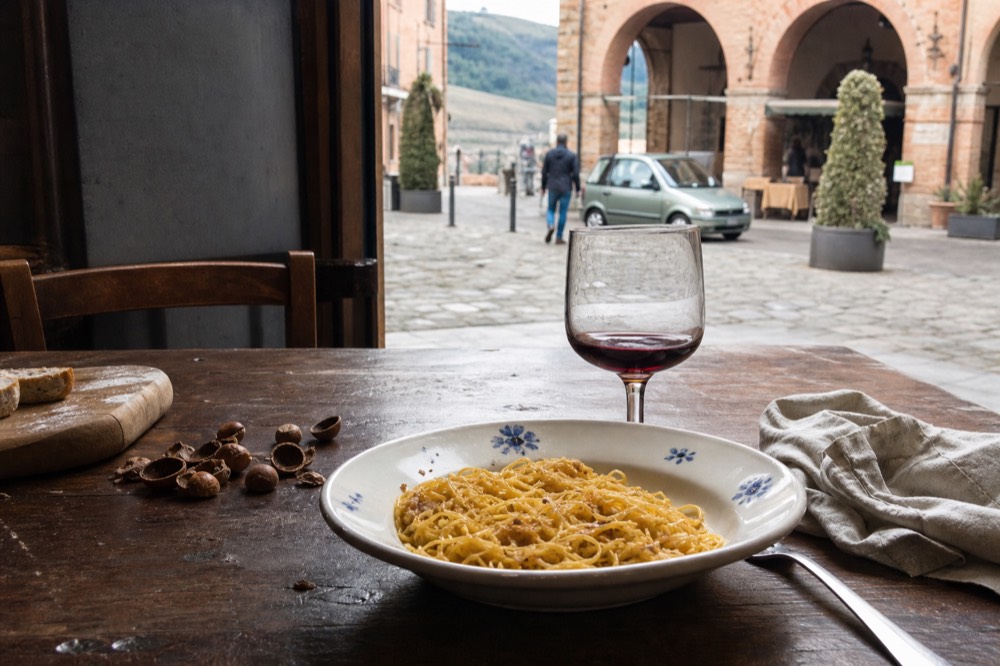
The wine list tells the same story with a twist. Piedmont's wine culture learned from France, then went its own way and arguably outdid the model. The region holds 60 denominations of origin, 19 DOCG and 41 DOC, according to the regional rural observatory's March 2026 note, and about 90 percent of its grapes go into DOC or DOCG wine, a share no French region matches. Barolo, aged 38 months minimum from 1 November of the harvest year, is made exclusively from Nebbiolo, a grape with no French analogue.
The Consorzio that protects these wines, the Consorzio di Tutela Barolo Barbaresco Alba Langhe e Dogliani, oversees nine denominations with over 550 member producers. Its very existence is the answer to the French question in liquid form: this is a wine region with its own native grapes, its own laws and its own institutions, older in cultivation than most of Europe's borders, in a landscape the UNESCO World Heritage Committee inscribed in 2014 as an archetype of European vineyards.
If tasting your way through that hybrid table sounds better than reading about it, the Monferrato side of the region is where the French-Italian blend is most edible. The Ovada CicloDiVino tour, about 4 hours of guided riding with food tastings from $93 per person, runs through Monferrato hills where the infernot, the hand-dug underground cellars that gave one UNESCO component its name, sit beneath village houses. It is a new listing without reviews yet, so check the live listing for current availability.
Is Piedmont Different From The Rest Of Italy?
Yes, and the differences are structural rather than cosmetic. Piedmont was the industrial and political engine of unification, its landscape is Alpine and vineyard rather than coastal, its food is butter-and-truffle rather than olive-oil-and-tomato, and its tourism is built around wine villages and slow travel rather than monuments and beaches. Visitors expecting postcard Italy are often surprised by how northern it feels.
Start with geography. Alba, the unofficial capital of the wine hills, sits at 179 metres above sea level, but the Langhe behind it climb relentlessly: La Morra's centre is at 508 metres, and Mombarcaro, the highest of the surveyed Langhe villages, tops out at 896 metres. The computed climbing figures for cyclists tell the story: a full loop of the Barolo villages from Alba covers about 68 km with roughly 877 metres of ascent, and the run up to Mombarcaro alone gains about 1,040 metres over 41 km. This is hill country, not the rolling Tuscan postcard.
Then there is the tourism rhythm. The Langhe, Roero and Monferrato recorded the strongest growth in Piedmont's 2025 tourism figures, with overnight stays up 11.9 percent, and the season now peaks outside the classic Italian summer. Summer 2026 actually exceeded the traditional autumn season in the Langhe and Roero, with May through August accounting for half of annual presences. The autumn truffle fair, the 96th Fiera Internazionale del Tartufo Bianco d'Alba, runs 10 October to 6 December 2026, and October is when Alba's short-let occupancy peaks.
The visitor profile is different too. Foreign overnight stays in the Langhe area reached 61 percent of the total in 2025, led by Switzerland and Liechtenstein, Germany, the Netherlands, France and the USA. That is a central European, wine-and-food visitor base, not the beach-and-ruins crowd of the coasts. It changes what the region offers: cellar doors, Michelin-listed osterias, and cycling routes between villages that all sit within about 20 km of Alba.
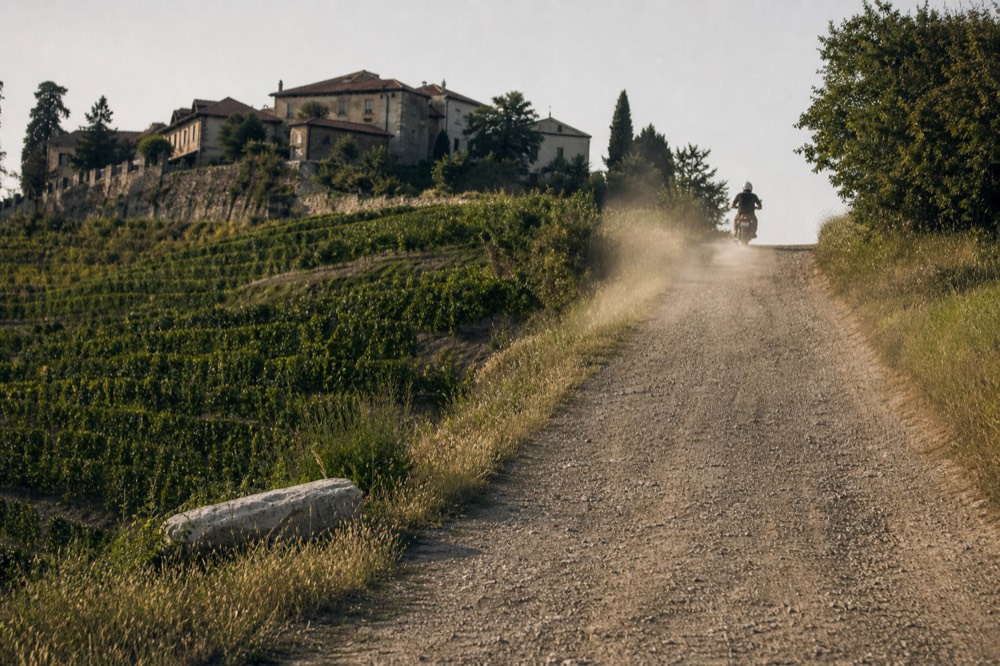
Cycling is where all these threads come together, and it is the reason Piedmont Bike Tours exists as a site. The vineyard landscape that earned UNESCO status is best seen at the speed of a bicycle, and the mix of French-feeling villages and Italian-feeling appetite makes a day on an e-bike here unlike a ride anywhere else in the country. For riders who want the full picture of the terrain, our guide to cycling in Piedmont covers the roads, the gradients and the surfaces in detail.
Which Part Of Piedmont Shows The Blend Best?
The Monferrato, east of Alba around Asti, Nizza Monferrato and Ovada, is where the French-Italian blend is most visible in a single day of riding: Savoy-era towns, UNESCO infernot cellars, Barbera vineyards and a kitchen that leans hardest into the court-cooking tradition. The Langhe shows the wine side of the story, but Monferrato shows the whole culture in miniature.
Monferrato is one of the six components of the UNESCO inscription, listed as "the Infernot of Monferrato" for its hand-carved underground cellars, and it is also the home of Nizza Monferrato, the Barbera town whose name appears on one of the denomination's most historic labels. The countryside here is gentler than the Langhe, the food is hearty, and the visitor numbers are lower, which makes it the region's quiet half.
The Nizza Monferrato mountain bike tour is the most physical way to see it: about 5 hours of riding from $250 per person, a new listing with no reviews yet, aimed at riders who want proper trails rather than tarmac. For something gentler, the e-bike options around Asti and Ovada cover the same culture with less effort, and the food-and-wine formats let you taste the French-Italian kitchen as you go.
Whichever you choose, the practical planning advice is the same. Spring and autumn are the best riding windows: May, June and September, with September's average high at Alba around 23.6 degrees, warm enough for short sleeves and timed to the harvest. July and August bring average highs near 29 degrees. The details, including what to pack for the vest law, are in our guide to the best time to visit Piedmont.
Piedmont is Italian in law, language and government, and it has been since the Italian state was founded in the nineteenth century with Turin as its first capital. The French feel is real but cultural: a name borrowed through French, a cross-Alpine royal history, and a kitchen shaped by court technique. The six questions below cover the details visitors ask most.
Common Questions About Piedmont's Identity
Is Piedmont French or Italian?
Italian. Piedmont is one of Italy's twenty regions with its capital at Turin, and it has been part of Italy since unification in the nineteenth century, when Turin was the first capital. The French feel comes from the name's route into English, the Savoy dynasty's cross-Alpine history and French influence on court cooking, not from any French political ownership.
Why does the name Piedmont sound French?
English borrowed the word through French, but Piemonte is simply Italian for "at the foot of the mountains." It is a geographic description of the region's position at the base of the Alps, not a linguistic claim.
Do they speak French in Piedmont?
No. Italian is the universal language. Local dialects and the minority languages of the western valleys belong to older Alpine linguistic families, so some words sound French-adjacent, but you will hear and need only Italian.
Is Piedmontese food French?
It is Italian food made with French-influenced technique. Sauces, broths and careful service came from the Savoy court, but the ingredients, white truffle, hazelnuts, beef, Barbera and Barolo, are entirely native to the region.
Was Turin ever a French city?
No. Turin was the capital of the Savoy state and then the first capital of unified Italy. Its royal architecture and arcaded streets show French and Central European influence, but the city was never French.
Is Piedmont worth visiting if I have seen Tuscany?
Yes, and it will feel like a different country. Piedmont offers vineyard hills under UNESCO protection, truffle season from October, France-adjacent cooking and serious cycling, with 60 denominations of origin and wine villages all within about 20 km of Alba.