What Is The Most Famous Piemontese Dish?
The most famous Piemontese dish, ranked honestly: tajarin with Alba white truffle, agnolotti del plin, bagna cauda and vitello tonnato, and where cyclists actually eat them.
 By Chiara Barbero, Piedmont Bike Tour Guide and Langhe Cycling Specialist
What Is The Most Famous Piemontese Dish?
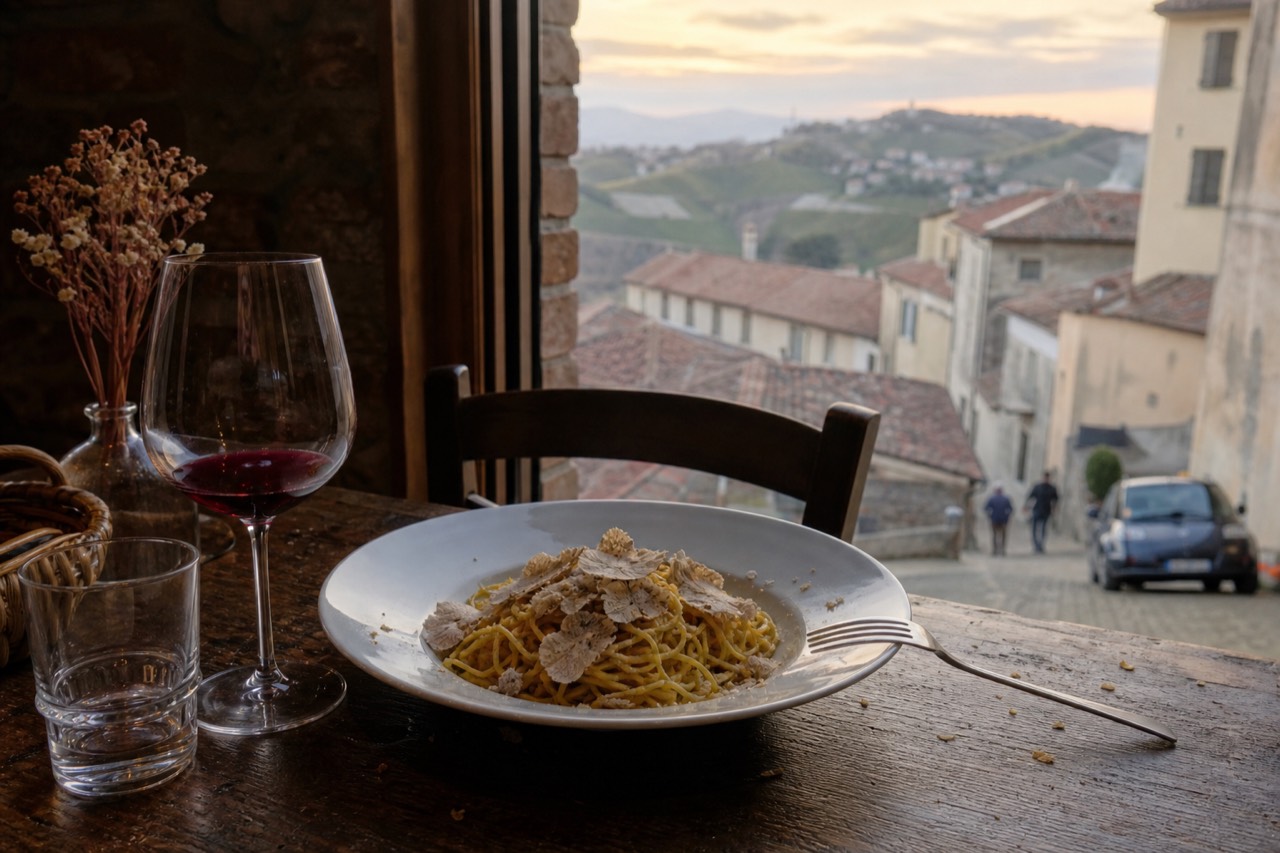
If one plate has to carry the title, it is tajarin, the thin hand-cut egg pasta of the Langhe, served with butter and shaved Alba white truffle. The truffle itself is the region's single most famous food, but it is a condiment, not a dish. Tajarin al tartufo is the plate that fuses the two, and it is the one that appears on every autumn menu, every food photograph and every visitor's memory of a Piedmont trip.
The case for tajarin is not just sentiment. The dish sits at the centre of what people actually travel here for. Piedmont recorded 6.733 million tourist arrivals and 18.172 million overnight stays in 2025, up 7.1 and 7.5 percent respectively, and the regional tourism data shows visitors arriving mainly for museums and enogastronomy. In the Langhe specifically, foreign overnight stays reached 61 percent of the total in 2025, led by Switzerland, Germany, the Netherlands, France and the USA. A large share of those visitors come to eat and drink, and tajarin with truffle is what they eat.
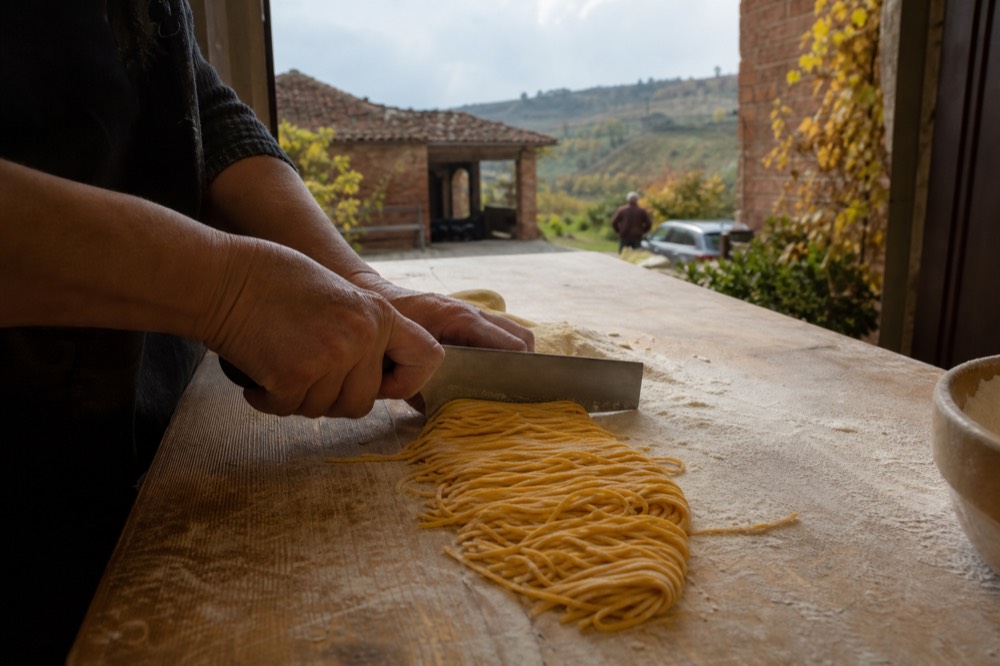
The pasta itself is a household product, not a restaurant invention. Tajarin are made with a high proportion of egg yolks, rolled thin and cut into fine strands a little narrower than spaghetti. Traditionally served with nothing more than butter and sage, or with the meat drippings of a Sunday roast, they become a destination dish in October and November when the white truffle season opens. The legal hunting season for Tuber magnatum in Piedmont runs from 1 October to 31 January, and the 96th International Alba White Truffle Fair runs 10 October to 6 December 2026, with the world truffle market open Saturdays and Sundays, per the fair's own official site. That is the window in which the most famous Piemontese dish is at its most famous.
It is also a window with a real price attached. White truffle is sold by weight, and in the hot, dry 2025 season market prices reached €2,500 to €7,000 per kilo, which is why restaurants shave it in front of you and charge accordingly. If the dish on your table carries truffle, expect the supplement to be listed per portion, and expect it to move with the market. This is the single biggest budget surprise for visitors in autumn, and it is worth knowing before you sit down.
Because a food pilgrimage and a bike day pair naturally here, the question of how to spend the hours before dinner matters as much as the dinner itself. These three rides are the ones our readers book most around the Barolo hills.
Which Other Dishes Compete For The Title?
Three dishes have a genuine claim. Agnolotti del plin, small pinched pasta parcels usually filled with roasted meat, is the strongest rival and the one locals defend hardest. Bagna cauda, the warm anchovy-garlic dip served with raw vegetables in late autumn, is the most communal. Vitello tonnato, cold sliced veal in a tuna-caper sauce, is the most exported and the one visitors usually recognise first.
Agnolotti del plin is the connoisseur's answer. The name comes from the pinch, il plin, that seals each parcel, and the filling is traditionally thrifty: the leftover roast of one meal, chopped and folded into pasta for the next. A well-made plin is served with minimal sauce, often just melted butter and a dust of parmesan, precisely because the filling carries the flavour. Every family in the Langhe has a version, and every version is, of course, the correct one.
Bagna cauda is the social answer. It appears in late autumn and winter, a warm bath of anchovies, garlic and olive oil into which raw and lightly cooked vegetables are dipped, cardoon and topinambour above all. The dish has a festival of its own, Bagna Cauda Day, spread across Asti and the wider region on set weekends in November, with a fixed menu formula around participating venues. You share one pot, you stay at the table for hours, and you leave smelling of garlic for two days. That is not a flaw, it is the point.
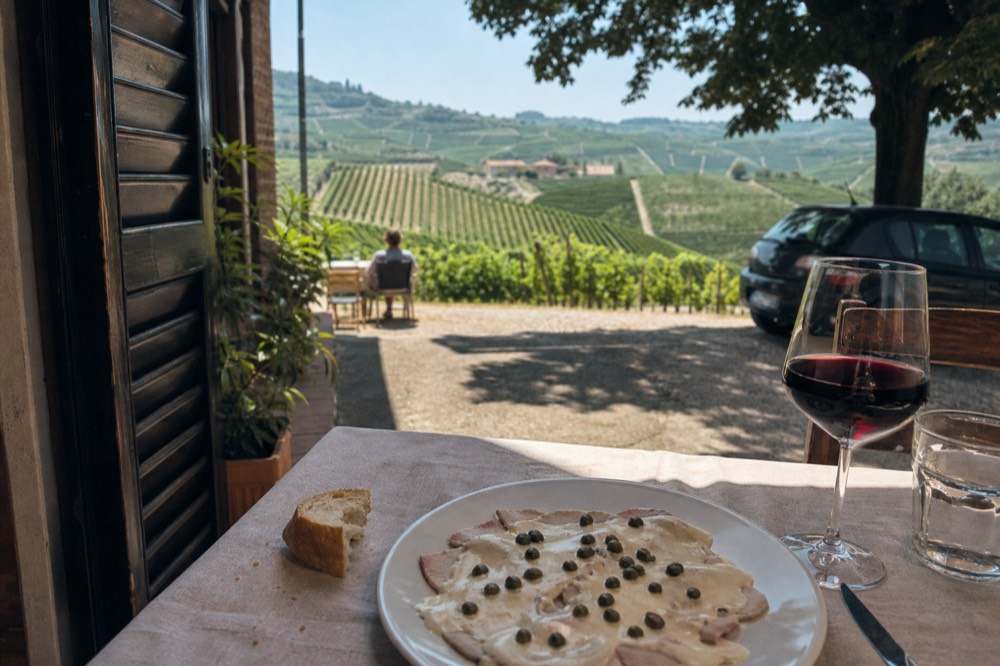
Vitello tonnato is the traveller's answer. Cold veal in a creamy sauce of tuna, capers, anchovies and egg appears on practically every Piemontese menu from April through September, and it has spread onto menus far outside the region, which is exactly why it is often the dish visitors name first when asked. If you come in summer, when the Langhe heat makes hot food unappealing, tonnato is the plate you will eat most.
| Dish | What it is | When locals eat it | Why it is famous |
|---|---|---|---|
| Tajarin al tartufo | Thin egg pasta, butter, shaved white truffle | October to January, truffle season | The definitive Langhe autumn plate |
| Agnolotti del plin | Pinched meat-filled pasta parcels | Sundays and feast days, all year | The dish locals defend hardest |
| Bagna cauda | Warm anchovy-garlic dip with vegetables | November and winter weekends | Communal ritual with its own festival |
| Vitello tonnato | Cold sliced veal, tuna-caper sauce | Spring and summer | The most exported Piemontese plate |
Where should you actually eat these? The Michelin Guide 2026 awarded four new Bib Gourmand entries in Piedmont, and the region now counts 34 Bib Gourmand listings, tied with Emilia-Romagna for the highest regional total in Italy, as Corriere reported. A Bib Gourmand signals good food at moderate cost, which is exactly the profile you want for tajarin and plin. Book ahead in October and November, when Alba's short-let occupancy peaks and tables follow suit.
Is White Truffle A Dish Or An Ingredient?
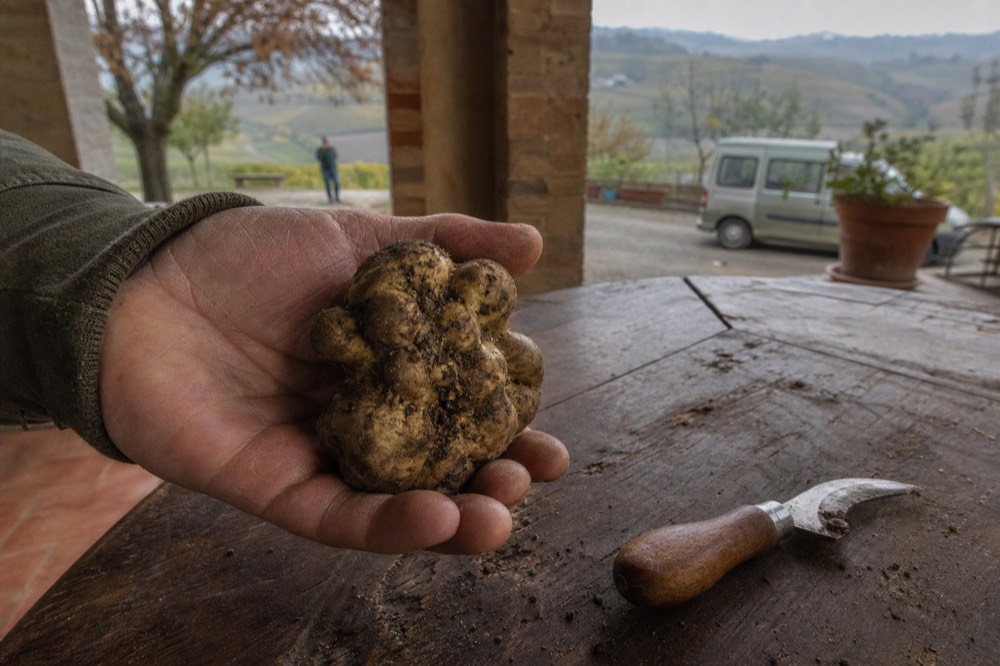
Strictly, it is an ingredient, and the region's law and calendar treat it that way. Tuber magnatum, the Alba white truffle, cannot be cooked into anything, because heat destroys its aroma, so it exists on the plate only as shavings over a finished dish. That is precisely why it crowns tajarin, risotto or fried egg rather than starring alone. Calling it the most famous Piemontese food is correct; calling it a dish is a category error.
The distinction matters to your wallet too. Truffle hunting experiences in the Langhe are listed from €50 per person in 2026 operator listings, with a second entry point around €60 for an outing with a local trifolau and dog. Those are listing prices rather than averages, but two independent aggregators agreeing on a €50-60 floor gives a usable planning range. The hunt is a morning or evening walk in the woods with a hunter and his dog, and it explains more about the dish than any restaurant can, because you see how rare and how weather-dependent the product is.
The weather dependency is not marketing talk. The 2026 season follows a brutal summer in the region, with a supercell storm on 7 August dropping 80mm of rain and hail on Langhe vineyards just before harvest, after record June heat that reached 39°C in Alessandria province. Truffle and harvest fortunes both swing on conditions like that, which is why the market price moves so much year to year, and why no honest page will promise you a fixed price per gram. If you are planning a trip around the food, the guide to truffle hunting in the Langhe covers the season in detail.
What Should You Eat After A Day Cycling The Langhe Hills?
After 60 to 70 km of Langhe hills, the plate that fits is the one that replaces everything you burned: tajarin with butter for fast carbs, agnolotti for protein, and a full-bodied Barbera or Dolcetto to wash it down. This is not a foodie affectation. These dishes were built for farming families working exactly the terrain you just rode.
The riding here is real. The Barolo villages loop from Alba runs about 68 km with roughly 877 m of climbing, linking Grinzane Cavour, La Morra, Barolo, Novello, Monforte d'Alba, Serralunga d'Alba and Castiglione Falletto, while the gentler Barbaresco loop from Alba covers about 36 km with around 457 m of ascent through Barbaresco, Neive and Treiso. Both finish within reach of Alba's restaurants. That is the practical shape of a perfect day here: ride the villages in the morning, eat the region's famous dishes at night. The pairing logic also comes from the terrain. Barolo needs 38 months of ageing, 18 of them in wood, counted from 1 November of the harvest year, and its tannic structure is precisely what stands up to the meat-rich, butter-rich plates of the region. Dolcetto and Barbera, the younger-drinking wines of the same hills, are what farming families drank daily with tajarin and plin, because Barolo was too precious to open every night. If you want the deeper background on that hierarchy, the Barolo versus Barbaresco comparison explains the two hills and their different cellar clocks.
For riders who want to build an entire trip around this rhythm rather than a single day, Piedmont Bike Tours exists for exactly that reason: matching the region's rides to its kitchens, without pretending the food is an afterthought. The private Langhe del Barolo e-bike tour is built around this structure: a six to seven hour ride on asphalt and dirt through the hills, ending back within dinner distance of Alba, rated 5 across 29 reviews and from $118 per person.
For a slower, picnic-centred version of the same day, the Barolo Wine Region e-bike tour through the vineyards runs 6 hours, is rated 4.0 across 5 reviews, and costs from $186 per person, which pairs well with a lighter dinner, or with skipping dinner in favour of a second picnic. It is worth adding that the hills reward the appetite. A rider who covers the full villages loop will burn a serious meal's worth of energy, and the Langhe portion sizes, built for people who work the land rather than sit at desks, are calibrated accordingly. This is the one region in Italy where cleaning your plate and ordering the second course can genuinely be described as recovery nutrition, and the trattorias around Alba and Barolo are used to cyclists doing exactly that.
Where Did These Dishes Actually Come From?
Most of the famous Piemontese plates are cucina povera, poor cooking, elevated rather than invented. Tajarin used the eggs and flour every farm had; agnolotti recycled Sunday's roast into Monday's pasta; bagna cauda stretched preserved anchovies and garlic into a winter meal for a whole table. The riches came later, layered on top by truffle and the great wines.
The anchovies in bagna cauda are the giveaway. Anchovies are salted fish, and the salt trade routes that crossed the region in past centuries carried them inland, where they became the base of a landlocked cuisine. The same is true of the tuna in vitello tonnato, a coastal product preserved and carried inland long before refrigeration. What looks like an odd pairing, veal with tuna, is a preservation-era solution that survived on flavour alone.
The wine economics are newer and worth knowing. Langhe Nebbiolo and Barbera d'Alba grape prices fell sharply in 2026, with Nebbiolo dropping to €2.70 per kilo from €4.30, while regional wine stocks rose 8.2 percent by July 2026 to 45.6 million hectolitres. Those pressures sit behind the scenes of every trattoria menu, but they do not change what you should order, only how you read the wine list. For the full picture of the region's food fame beyond one dish, our what is Piedmont famous for piece covers the truffle, the wine and the chocolate trade together, including the hazelnut economics behind the region's most exported confection.
There is also a growth story worth a sentence. In the Langhe, Monferrato and Roero area, short-term rental accommodation has increased 500 percent over six years through 2025, a shift that has real costs for residents, as local reporting has documented, but which also reflects how strongly the food and wine now draw visitors. Summer 2026 visitor numbers in Langhe and Roero exceeded the traditional autumn season, with May to August accounting for half of annual presences, per La Stampa. The truffle autumn remains the classic season, but the kitchen is working all year now, and if you ride here in May you will eat almost as well as in October, at lower prices and with the vineyards in spring green.
Before deciding how to structure your own food-and-ride day, these are the three tours most of our readers choose in the Barolo hills.
Tajarin with shaved Alba white truffle holds the title, with agnolotti del plin, bagna cauda and vitello tonnato close behind. The white truffle season runs from 1 October to 31 January in Piedmont.
Common Questions About The Most Famous Piemontese Dish
What is the most famous piemontese dish?
Tajarin, thin hand-cut egg pasta, served with butter and shaved Alba white truffle. The white truffle is the region's most famous food, but as a condiment rather than a dish, so the plate that carries the title is tajarin al tartufo. Agnolotti del plin, bagna cauda and vitello tonnato are the strongest runners-up.
Is the Alba white truffle a dish?
No, it is an ingredient, and it is never cooked, because heat destroys its aroma. It appears only as raw shavings over finished dishes such as tajarin, risotto or fried egg. The legal hunting season for Tuber magnatum in Piedmont runs from 1 October to 31 January.
When is the best time to eat truffle dishes in Alba?
October and November. The Alba White Truffle Fair runs 10 October to 6 December 2026, with the world truffle market open on Saturdays and Sundays, and online tickets cost €6 plus fees, including entry to the MUDET museum. Restaurant truffle supplements move with the market price, so expect them to be listed per portion.
What is bagna cauda?
A warm dip of anchovies, garlic and olive oil served with raw and cooked vegetables in late autumn and winter. It is a communal dish, shared from one pot, and it has its own festival weekends, Bagna Cauda Day, across Asti and Piedmont in November and January.
What wine goes with tajarin and agnolotti?
Locally, Dolcetto or Barbera for everyday plates, and Barolo or Barbaresco for special occasions, matching the tannic structure of Nebbiolo against the butter and meat richness of the dishes. The choice mirrors how farming families drank: the precious bottles saved, the everyday wines opened.