What Are The Most Beautiful Villages In The Langhe?
The most beautiful villages in the Langhe, from Barolo and La Morra to Neive and Serralunga d'Alba, and how they link up into a single day of riding.
 By Chiara Barbero, Piedmont Bike Tour Guide and Langhe Cycling Specialist
What Are The Most Beautiful Villages In The Langhe?
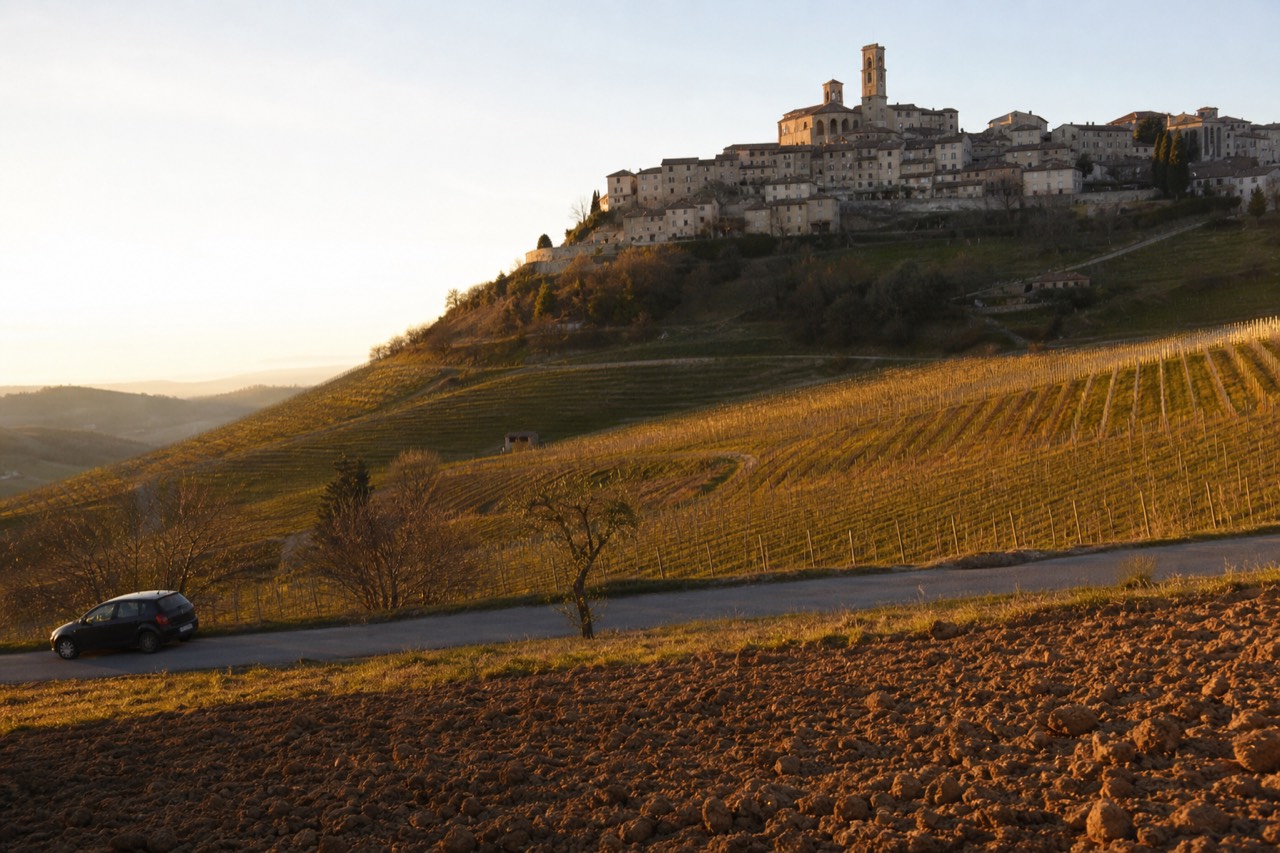
The villages most often named the Langhe's most beautiful are Barolo, La Morra, Serralunga d'Alba, Monforte d'Alba, Castiglione Falletto and Novello on the Barolo side, and Neive, Barbaresco and Treiso on the Barbaresco side. All nine sit inside about 20 km of Alba, which is the fact that matters most here: they are not scattered sights but one contiguous landscape you can ride between.
The Langhe is a compact hill region, not a long one. Alba, the working town at its centre, stands 179 m above sea level, and the famous wine villages ring it at distances measured in single-digit kilometres from each other. Barolo is about 14 km from Alba by road, La Morra about 16, Monforte d'Alba about 20. Barolo to La Morra is 6 km. Barolo to Monforte is under 7. The whole postcard belt is, geographically speaking, one afternoon's ride for anyone on a pedal-assist bike, and a satisfying full day for anyone on a road bike who stops to look around.
That compactness is what makes a question like this answerable in a way a listicle never manages. A first page of search results will tell you that Barolo is pretty and that La Morra has a viewpoint. Both are true. What it will not tell you is that the villages chain together, that the riding between them is the best scenery of the day, and that the choice between them is really a choice of loop.
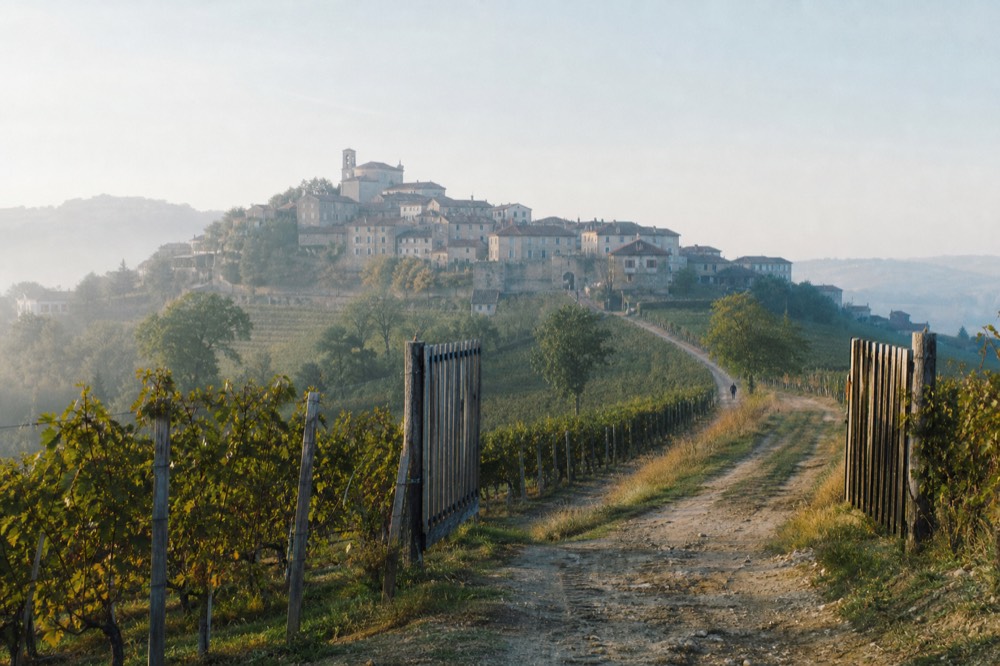
Start with the headline names. Barolo itself is small, 613 residents, and its fame rests on the wine named after it rather than on size. The village climbs to its castle, home to the WiMu wine museum, and the streets below are almost entirely given over to cellars and enoteche. La Morra, at 508 m the highest of the main villages, is the viewpoint of the region: its terrace looks south across the whole Barolo amphitheatre, and on a clear afternoon you can pick out Serralunga's castle and the Alta Langa beyond. Monforte d'Alba has the most dramatic setting of the three, its old quarter stacked on a prow of hill above the vineyards, with a modern glass concert pavilion wedged into the medieval square.
The quieter names deserve their place too. Serralunga d'Alba, 484 residents, holds the region's most photogenic building, a slender turreted medieval castle that looks exactly like the castle a child would draw. Castiglione Falletto is a working village in the exact middle of the Barolo zone, and Novello, at 473 m, is the one visitors skip and photographers do not. Verduno, which received a Bandiera Arancione from the Touring Club Italiano, rounds out the ridge.
If you want to see them the way this site is built around seeing them, these three tours cover the spread: a private guided loop, a scenic guided ride with tasting, and a self-guided rental day.
Which Villages Link Up Into One Ride?
Yes, and that is the real answer to this question. A loop from Alba through Grinzane Cavour, La Morra, Barolo, Novello, Monforte d'Alba, Serralunga d'Alba and Castiglione Falletto, with Verduno nearby, back to Alba measures about 68 km with roughly 877 m of climbing, and it passes through every major Barolo-side village except Verduno. Those figures are computed from real route geometry over the road network, not an operator's brochure, so treat them as close approximations rather than gospel.
The loop is the reason to base yourself in Alba or La Morra rather than commuting in. Ride out of Alba north to Grinzane Cavour first, about 7.5 km, where the castle of the same name, a UNESCO component in its own right, sits above the village where Camillo Benso di Cavour once worked the estate. From there the road climbs to La Morra, about 329 m of ascent from the valley, and the terrace stop writes itself. The descent to Barolo is fast and open, then the route rolls through Novello and Monforte before the two castle villages, Serralunga and Castiglione Falletto, and the run home past the vineyards of the Serralunga ridge.
The UNESCO inscription that covers this landscape, the Vineyard Landscape of Piedmont: Langhe-Roero and Monferrato, was added to the World Heritage List in 2014 and takes in six components, five winegrowing areas plus the Castle of Cavour at Grinzane. The Barolo Langa and the Hills of Barbaresco are two of those components, which is a formal way of saying the two prettiest riding belts in the region are the ones UNESCO drew a line around. The official component list is published by the site management association.
A note on infrastructure, because it is easy to get wrong. There is a funded plan for a 32.5 km cycle route, the Ciclovia delle Colline Unesco, linking Alba to Canelli through these hills, but it is not built. No rider can ride it today. The villages loop above is on ordinary country roads, shared with cars and tractors, and that is the honest picture of Langhe riding.
One practical point that catches visitors: outside built-up areas, Italian law requires a reflective vest when riding between half an hour after sunset and half an hour before sunrise, and in tunnels at any hour. A late-September loop that finishes near dusk crosses that line easily.
Wondering whether to book a guided loop or ride it on your own?
Is Barolo Or La Morra The Better Village To Base Yourself In?
La Morra is the better base for views and quiet, standing at 508 m with the region's best terrace and 2,626 residents spread across a large comune. Barolo is the better base for wine logistics, with the castle, the WiMu museum and a dense strip of cellars, but the village itself is tiny, just 613 residents, and it fills and empties with day visitors. The honest answer is that most people are happier sleeping in La Morra and visiting Barolo.
The two are 6 km apart, so the choice is less dramatic than it looks. What differs is the texture of the days. La Morra mornings are fog rolling off the Tanaro and a bakery; Barolo mornings are a coach party arriving at the castle before the tastings open. By late afternoon the positions reverse, and Barolo empties into one of the loveliest quiet hours in the region, when the day-trippers have gone and the village belongs to the people staying in it.
The Barolo zone itself is bigger than the village. The production rules name 11 comuni, of which only Barolo, Castiglione Falletto and Serralunga d'Alba lie entirely inside the zone; the other eight, including La Morra, Monforte, Novello, Verduno, Grinzane Cavour, Diano d'Alba, Cherasco and Roddi, are partly in. So "staying in the Barolo hills" covers a wide belt, and almost any bed in it puts you within a short ride of the famous names.
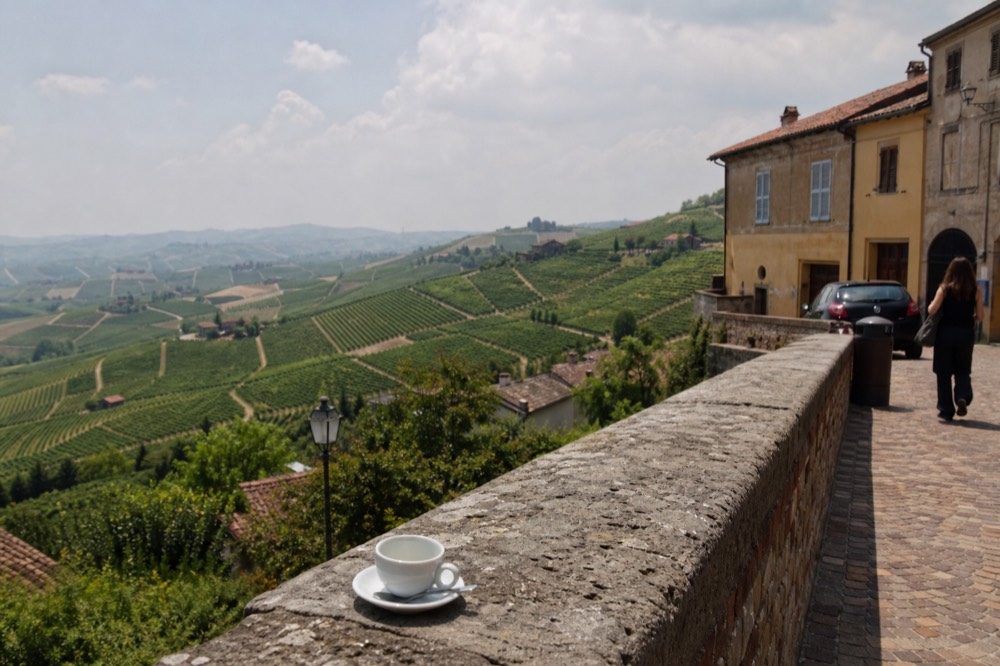
For riders, the geometry favours La Morra slightly: it sits at the top of the loop, so you can descend toward Barolo with the day ahead of you rather than climb into it at the end. The climb from the valley to La Morra gains roughly 329 m, and no verified gradient figures exist for any named Langhe climb, so plan on height gained rather than percentages. Our guide to Barolo bike tour routes breaks the individual village links down in detail.
The private option that covers this exact belt is the Langhe del Barolo private e-bike tour, a 6 to 7 hour guided ride on asphalt and dirt roads through the Barolo-side villages, rated 5 across 29 reviews, from $118 per person. Because it is private, the village stops bend to your pace, which is the difference between seeing La Morra's terrace and lingering on it.
What About Serralunga, Monforte And Novello?
Serralunga d'Alba has the single most striking building in the Langhe, its turreted medieval castle; Monforte d'Alba has the most dramatic village setting, stacked on a hilltop prow at 472 m; and Novello, at 473 m, is the quiet ridge village that most visitors miss. None of the three needs more than an hour, and all three sit on the same loop, so skipping them saves almost no distance.
Serralunga rewards a slow circuit of the castle's base rather than a tour, though the interior is open in season. The village has 484 residents and one main street, and the castle rising above it is the image that ends up on Langhe postcards whether the photographer knows the name or not. Monforte is the one that surprises people: the old borgo climbs a narrow spur, and the modern auditorium built into the summit square is a piece of contemporary architecture that works, framing the valley through glass. Novello, a few kilometres west, is the least visited of the ridge villages and has some of the best light in the late afternoon, when the sun drops toward the Alps behind the vineyards.
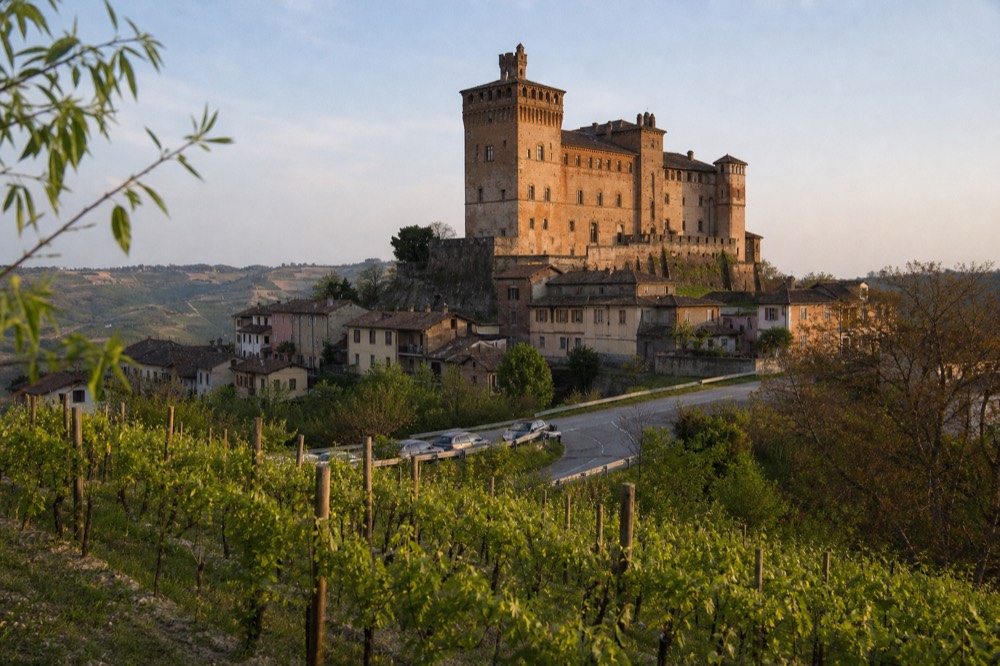
A guided half-day that reaches the same ridge is the Barolo scenic e-bike tour with wine tasting, about 5 hours from $186 per person, which threads the vineyards between the castle villages and finishes in a cellar. For riders who would rather set their own village order, the Langa del Barolo e-bike rental, from $52 per person for a full day, puts the same hills under you without a schedule.
Are The Barbaresco Villages Worth The Detour?
Yes. Neive, Barbaresco and Treiso form a second, softer belt of villages about 13 to 15 km east of Alba, and a loop from Alba through Barbaresco, Neive and Treiso measures about 36 km with roughly 457 m of climbing, roughly half the effort of the Barolo loop. If the Barolo side is castles and amphitheatres, the Barbaresco side is lanes, towers and orchards.
Neive is arguably the single prettiest village of the whole region, and it is the one locals name when you ask them rather than a search engine. Its stacked old centre, a tangle of stone lanes around a campanile, won it a place among Italy's borghi più belli, and at 3,192 residents it has enough life to hold a couple of good trattorias. Barbaresco, 600 residents, sits lower at 262 m, dominated by its medieval tower above the Tanaro, with the river plain spread below. Treiso, the highest of the three, looks back west across the whole Barolo belt.
The riding between them is gentler than the Barolo side and the traffic thinner, which makes this loop the better choice for a second day in the region, or for a first day if 68 km sounds like more village than you need. The two sides are also, in wine terms, the same grape grown on different ground: Barbaresco's production rules require 100% Nebbiolo aged a minimum of two years including nine in oak, against Barolo's 38 months including 18 in wood. Our comparison piece on Barolo versus Barbaresco covers what that means in the glass and on the road.
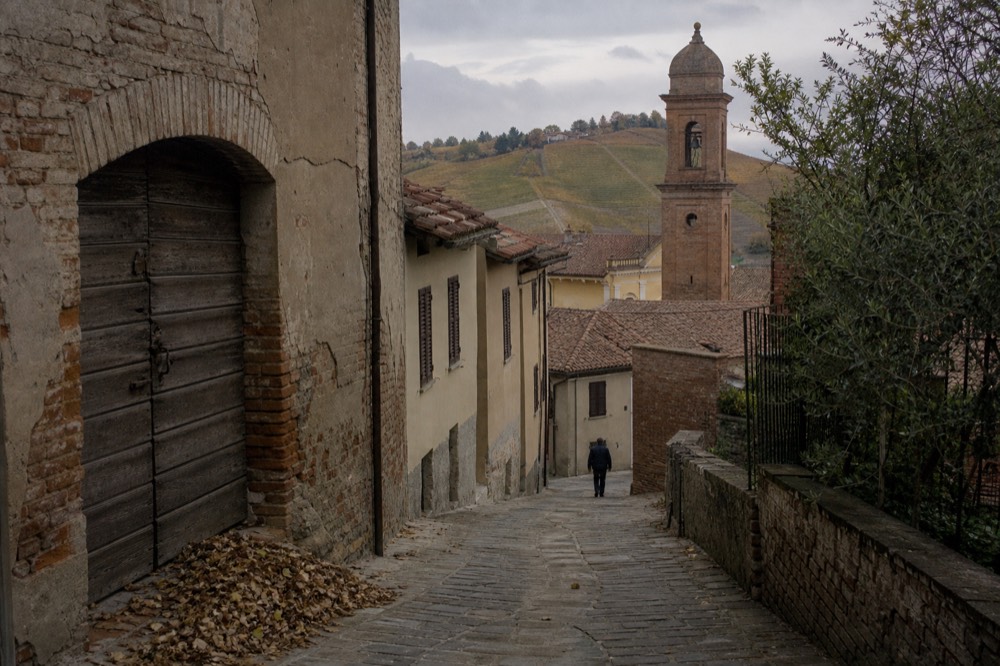
The table below puts the headline villages side by side, with elevations and populations from the official ISTAT-derived comune data and road distances computed over the actual road network from Alba's centre.
| Village | Elevation (m) | Residents | Distance from Alba | What it is known for |
|---|---|---|---|---|
| Barolo | 303 | 613 | about 14 km | Castle, WiMu museum, the wine's home |
| La Morra | 508 | 2,626 | about 16 km | The panoramic terrace over the Barolo hills |
| Serralunga d'Alba | 390 | 484 | about 15 km | The turreted medieval castle |
| Monforte d'Alba | 472 | 1,864 | about 20 km | Hilltop old quarter and auditorium |
| Castiglione Falletto | 349 | 655 | inside the loop | Central position in the Barolo zone |
| Novello | 473 | 921 | inside the loop | Quiet ridge village, evening light |
| Neive | 294 | 3,192 | about 13 km | Stacked stone borgo, among Italy's borghi più belli |
| Barbaresco | 262 | 600 | about 13 km | Medieval tower above the Tanaro |
| Treiso | data not verified | data not verified | south of Barbaresco | High viewpoint back over the Barolo belt |
When Is The Best Time To See The Langhe Villages?
September and October are the best months: the harvest brings the vineyards to life from late September, the vines turn gold and red through October and November, and Alba's white truffle fair runs from 10 October to 6 December. May and June come close, with warm days and green hills before the summer heat arrives.
The harvest is the spectacle. Nebbiolo, the grape behind both Barolo and Barbaresco, comes in from late September, and Barolo fruit is usually the last off the hill in early October. Riding the village lanes in those weeks means sharing them with tractors hauling crates, which is charming and also a reason to keep your eyes up on the descents. After the pick, the leaves change: Nebbiolo turns yellow, Dolcetto red, and no source in the region will commit to a precise peak week, the colour moves across October and November with the weather.
Autumn is also the busiest season in Alba, and the truffle fair is the reason. Hotel demand in the town peaks in October, and the weekend market days draw crowds into the historic centre. If you want the harvest colours without the fair crowds, the second half of October after the first fair weekends, or early November, is the quieter window, though November is also the wettest month of the year in these hills.
Summer has its own argument: the days are long, the evenings are warm, and the light on the ridge villages at 8 pm is extraordinary. The trade-off is heat, with average July highs around 29 °C in the Alba area, and the August closure period, when a fair number of family-run cellars and kitchens shut for holidays. Our best time to visit Piedmont guide works through the full calendar, and our piece on where to stay in the region covers the village-by-village base choice in more depth than this page can.
However you time it, the villages themselves are the constants. Barolo will have 613 residents and a castle whether you arrive in fog or in harvest sun, and the loop between them will still be about 68 km of the most rideable wine country in Italy. That is the pitch this site is built on, and Piedmont Bike Tours exists because the answer to "which village is most beautiful" turns out to be "the next one on the road".
If you are weighing the options, these three cover the range: a private full loop, a guided scenic half-day with tasting, and a self-guided rental for riders who want to build their own village list.
The nine villages that come up again and again are Barolo, La Morra, Serralunga d'Alba, Monforte d'Alba, Castiglione Falletto, Novello, Neive, Barbaresco and Treiso, and the practical way to judge them is not village by village but loop by loop, because all nine link into rides of roughly 36 or 68 km from Alba. The questions below cover the ones readers ask most, from which village to sleep in to which month gives the best light on the hills.
Common Questions About The Langhe's Most Beautiful Villages
What are the most beautiful villages in the Langhe?
Barolo, La Morra, Serralunga d'Alba, Monforte d'Alba, Castiglione Falletto, Novello and Verduno on the Barolo side, plus Neive, Barbaresco and Treiso on the Barbaresco side. All of them sit within about 20 km of Alba and link into rides of roughly 36 km (Barbaresco loop) or 68 km (Barolo loop).
Can you cycle between the Langhe villages in one day?
Yes. A loop from Alba through Grinzane Cavour, La Morra, Barolo, Novello, Monforte d'Alba, Serralunga d'Alba and Castiglione Falletto is about 68 km with roughly 877 m of climbing, very achievable on an e-bike and a solid day on a road bike. The shorter Barbaresco loop is about 36 km with roughly 457 m of climbing.
Which is the best village to stay in?
La Morra for views and quiet, Barolo for wine logistics and cellars, Monforte d'Alba for a dramatic setting with good restaurants, and Alba if you want a real town with trains and services at the centre of everything. Barolo and La Morra are only 6 km apart, so the choice matters less than it seems.
Is Neive or Barbaresco prettier?
Neive is the more conventionally beautiful village, a stacked stone borgo recognised among Italy's borghi più belli, with lanes, a campanile and enough residents to keep it alive. Barbaresco is smaller and lower, dominated by its medieval tower above the Tanaro, and works better as a stop on a ride than as a base.
When is the best month to visit the Langhe villages?
September and October, for the harvest and the start of the vine colours, with the white truffle fair in Alba running 10 October to 6 December. May and June are the best green-season alternative. July and August bring heat and some cellar closures, and November is the wettest month.