Barolo Bike Tour Routes: The Villages, Distances And Climbing Between Them
Every Barolo bike tour listing shows you a price and a glass of wine. Almost none show you the route. Here is the actual geography: which villages the rides pass through, how far apart they sit, and how much climbing separates them.
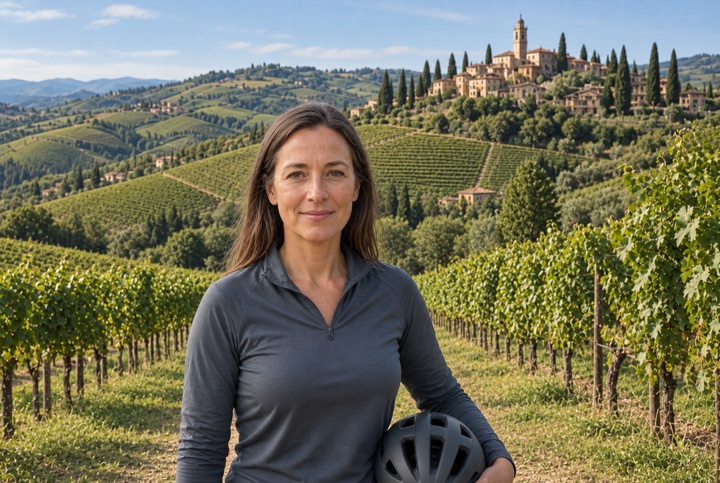 By Chiara Barbero, Piedmont Bike Tour Guide and Langhe Cycling Specialist
Short answer
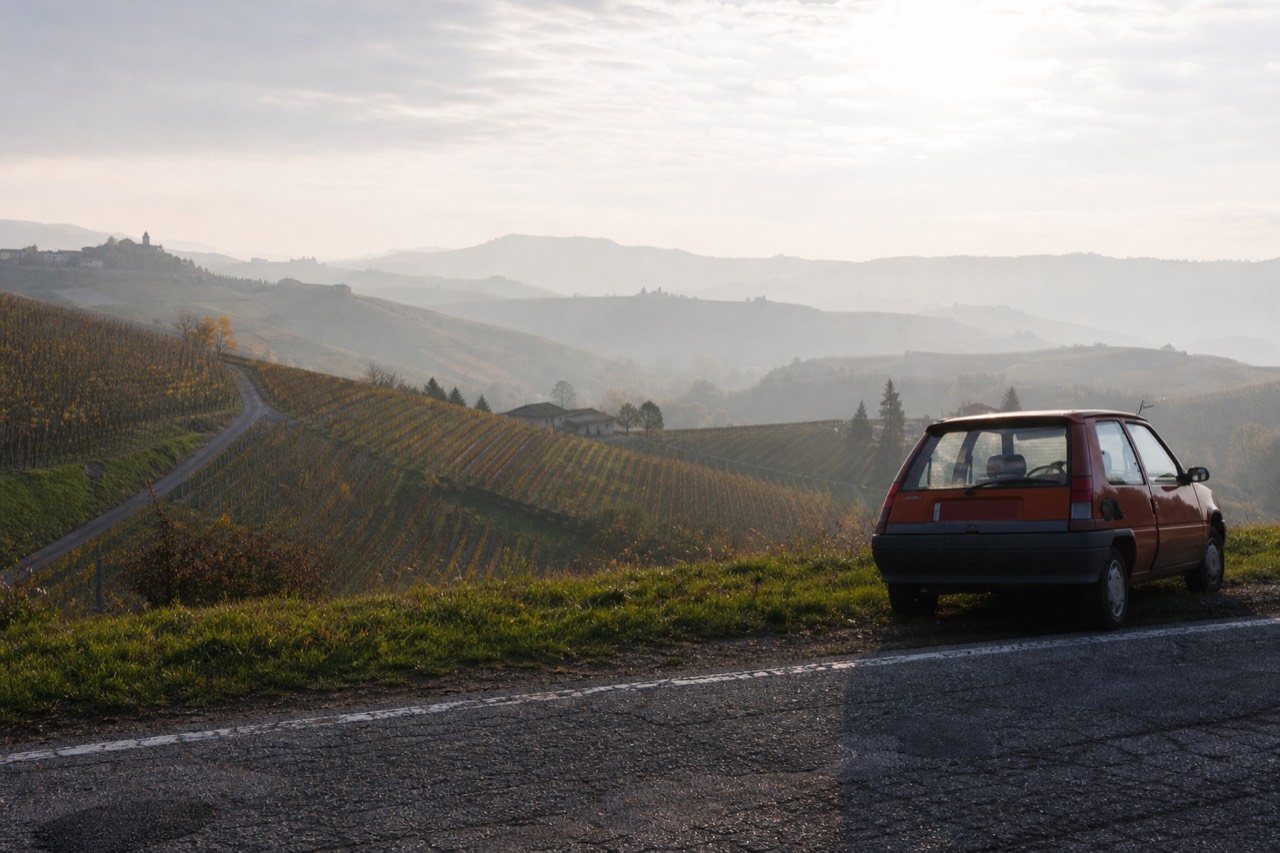
A Barolo bike tour runs through the 11 communes of the Barolo DOCG zone, nearly all within about 20 km of Alba. A full village loop from Alba is roughly 68 km with about 877 m of climbing. E-bike tours typically cover a 15 to 20 km slice of the same hills with a cellar stop included.
What Villages Does A Barolo Bike Tour Actually Pass Through?
A Barolo bike tour passes through the vineyard hills of the 11 communes of the Barolo DOCG production zone: Barolo, Castiglione Falletto and Serralunga d'Alba entirely, plus La Morra, Monforte d'Alba, Novello, Verduno, Grinzane Cavour, Diano d'Alba, Cherasco and Roddi in part. Most tours touch three to five of these, strung together on the ridge roads south of Alba.
That list comes straight from the official Barolo disciplinare, the production rules published by the Consorzio di Tutela Barolo Barbaresco Alba Langhe e Dogliani, not from any operator brochure. It matters for a rider because the eleven communes are not interchangeable. Barolo itself, with 613 residents, is a compact village around a castle; La Morra sits at 508 m, the highest of the famous communes, with the long views that implies; Grinzane Cavour, at 201 m, is the low entry point closest to Alba and carries the UNESCO-listed castle component of the World Heritage inscription.
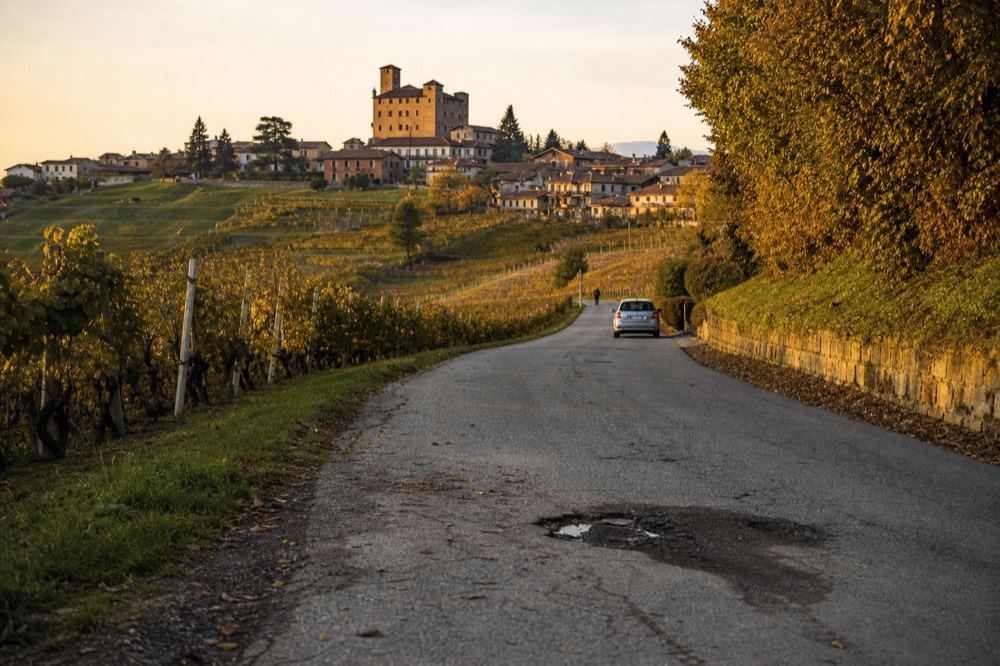
When a listing names its stops, you can now place them. A tour advertising Barolo, La Morra and Grinzane Cavour is riding the western flank, closer to Alba, gentler in and out. A tour naming Serralunga d'Alba, Monforte d'Alba and Castiglione Falletto is on the eastern and southern side, the more sinuous half of the zone. If a listing names none of its villages at all, that vagueness is the first thing to question before booking.
The wider frame is the UNESCO Vineyard Landscape of Piedmont: Langhe-Roero and Monferrato, inscribed in 2014 across six components, of which the Langa of Barolo is one. For the broader picture of how the three wine areas fit together, see the Piedmont Italy map explained. This site's own coverage, from Piedmont Bike Tours, focuses on what a rider can do with the geography, and this article is the route-level detail for the Barolo hills specifically.
How Far Apart Are The Barolo Villages On The Bike?
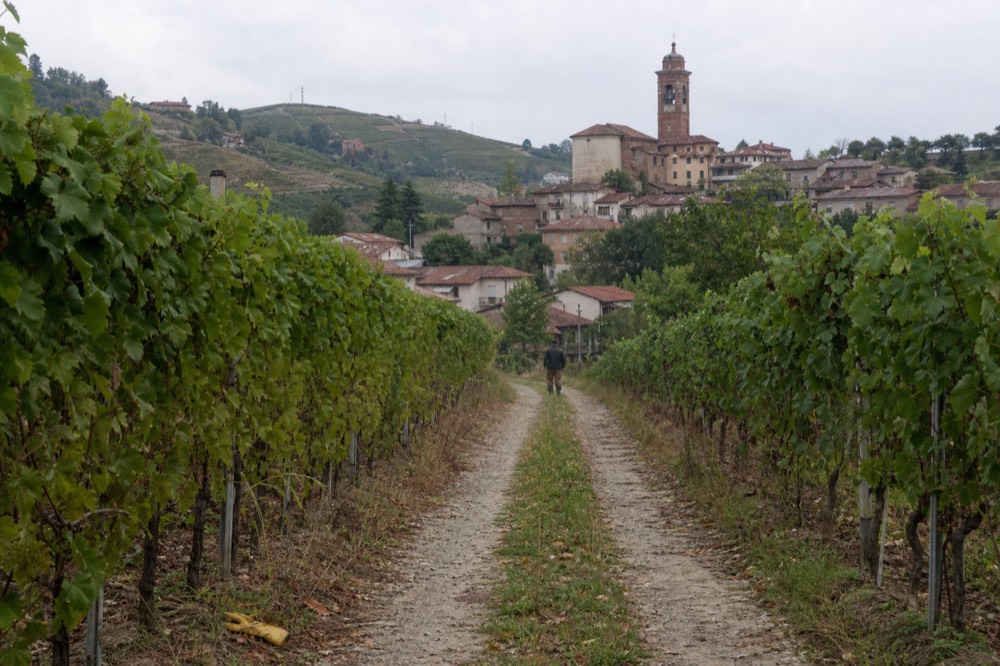
Every famous Barolo and Barbaresco village sits within roughly 20 km of Alba. Computed road distances: Alba to Barolo is about 13.9 km, Alba to La Morra about 15.8 km, Alba to Monforte d'Alba about 19.6 km, Alba to Serralunga d'Alba about 15.5 km, and Barolo to La Morra just 6 km. A full loop linking all the main Barolo villages from Alba comes out at about 68 km.
Those distances are computed over the OpenStreetMap road network, so treat them as "about", not as surveyed figures, but the shape is solid: this is a compact zone. A five-hour guided e-bike tour with a cellar stop is not covering 68 km; it is covering a well-chosen 15 to 20 km slice of ridge road with the best views and one or two village stops.
Here are the distances a Barolo rider actually cares about:
| Route | Distance (km) | Approx. drive time (min) |
|---|---|---|
| Alba → Grinzane Cavour | 7.5 | 10 |
| Alba → Barolo | 13.9 | 16 |
| Alba → Serralunga d'Alba | 15.5 | 17 |
| Alba → La Morra | 15.8 | 17 |
| Alba → Monforte d'Alba | 19.6 | 23 |
| Barolo → La Morra | 6.0 | 8 |
| Barolo → Monforte d'Alba | 6.8 | 9 |
The practical reading: the village-to-village hops are short, which is exactly why this area became wine-touring territory in the first place. Barolo to La Morra is a morning warm-up, not a stage. What stops a rider covering all eleven communes in a day is not distance but the vertical, which is the next question.
If you are comparing actual products rather than planning your own line, these three cover the classic circuit at three different intensities and price points:
The guided scenic e-bike tour is the roughly five-hour, from $186 per person format with a wine tasting built in. Langhe Slow runs about 5.5 hours between Serralunga d'Alba and Barolo on the UNESCO-heritage hills, from $157 per person, and suits riders who want the named-village experience at a steadier pace. The picnic version is about six hours through the vineyards from $93 per person, the value end of the same terrain. Same hills, three different ways of slicing them.
How Much Climbing Should You Expect On A Barolo Route?
A full Barolo villages loop from Alba, linking Grinzane Cavour, La Morra, Barolo, Novello, Monforte d'Alba, Serralunga d'Alba and Castiglione Falletto, is about 68 km with roughly 877 m of ascent, topping out near 521 m. The one-way run from Alba up to La Morra alone gains about 329 m over 15.8 km. The valley floor at Alba sits at 139 m; La Morra's centre stands at 508 m.
That 877 m is a computed figure, derived from the real road geometry and a digital elevation model, so treat it as a solid estimate rather than an operator's route card. It is also the single best number for deciding between a road bike and an e-bike: on pedal assist, 877 m spread over 68 km is a comfortable day; under muscle alone, with August heat, it is a serious ride.
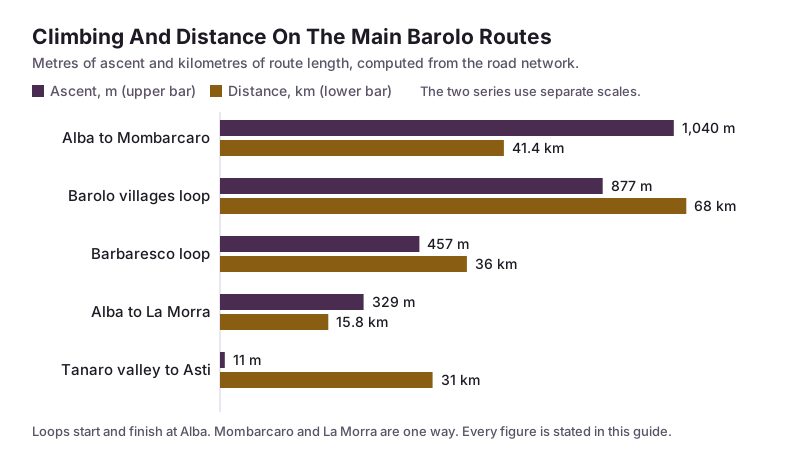
No named climb in the Langhe has a verified gradient, so this site reports height gained, never percentages. The vertical intervals, from official comune elevation data, are what matter for planning:
| Comune | Centre elevation (m) | Territory range (m) |
|---|---|---|
| Alba | 179 | 139–591 |
| Grinzane Cavour | 201 | 182–305 |
| Barolo | 303 | 213–480 |
| Serralunga d'Alba | 390 | 202–446 |
| Castiglione Falletto | 349 | 197–370 |
| La Morra | 508 | 186–556 |
| Monforte d'Alba | 472 | 213–561 |
| Novello | 473 | 212–483 |
Read the table as the rhythm of a Barolo day. You descend from Alba to near the valley, then you pay for every ridge village with 150 to 350 m of climbing, and the descents in between are short and fast. La Morra and Monforte d'Alba are the two big payments; Grinzane Cavour is the cheap first instalment.
And when a rider has had enough of vertical, there is a genuine flat escape: the Tanaro valley from Alba toward Asti is about 31 km with almost no cumulative ascent, 11 m by the computed profile, between towns whose centres differ by under 50 m. It is the recovery ride this region owes you. For more on the region's terrain logic, see cycling in Piedmont.
If that vertical is the part that worries you, the guided scenic e-bike tour is the format that answers it: pedal assist over the same ridge roads, with a cellar tasting at the end.
Barolo Loop Or Barbaresco Loop: Which Route Suits You?
A Barbaresco loop from Alba, via Barbaresco, Neive and Treiso, is about 36 km with roughly 457 m of ascent. The Barolo villages loop is about 68 km with roughly 877 m. Same starting town, same grape family on the hills, and nearly a factor of two in both distance and climbing. Barbaresco is the half-day choice; Barolo is the full-day choice.
The two loops also differ in character, not just size. The Barbaresco side, on the right bank of the Tanaro facing Alba, is rolling and quick to reach, with Neive at 294 m and Barbaresco at 262 m, both gentler than the 500 m ridge on the Barolo side. The Barolo side has the longer views, the UNESCO-listed village core of Barolo itself, and the stonier, more theatrical descents. For a deeper comparison of the two wines and their hills, read Barolo vs Barbaresco.
| Loop from Alba | Distance | Ascent | High point | Character |
|---|---|---|---|---|
| Barbaresco loop (Barbaresco, Neive, Treiso) | ~36 km | ~457 m | ~410 m | Half-day, rolling, quick access |
| Barolo villages loop (7 communes) | ~68 km | ~877 m | ~521 m | Full day, ridge riding, the classic |
| Alba → Mombarcaro, one way | ~41 km | ~1,040 m | 858 m | Alta Langa, serious climbing |
A format note for the planning stage: if you want a private guide and a route shaped around your own legs, the private "Langhe del Barolo" e-bike tour runs 6 to 7 hours on asphalt and dirt roads, rated 5 across 29 reviews, from $118 per person, which is less than several of the shared formats because you are paying for the bike and guide rather than a tasting package.
What Are The Roads And Surfaces Like On A Barolo Route?
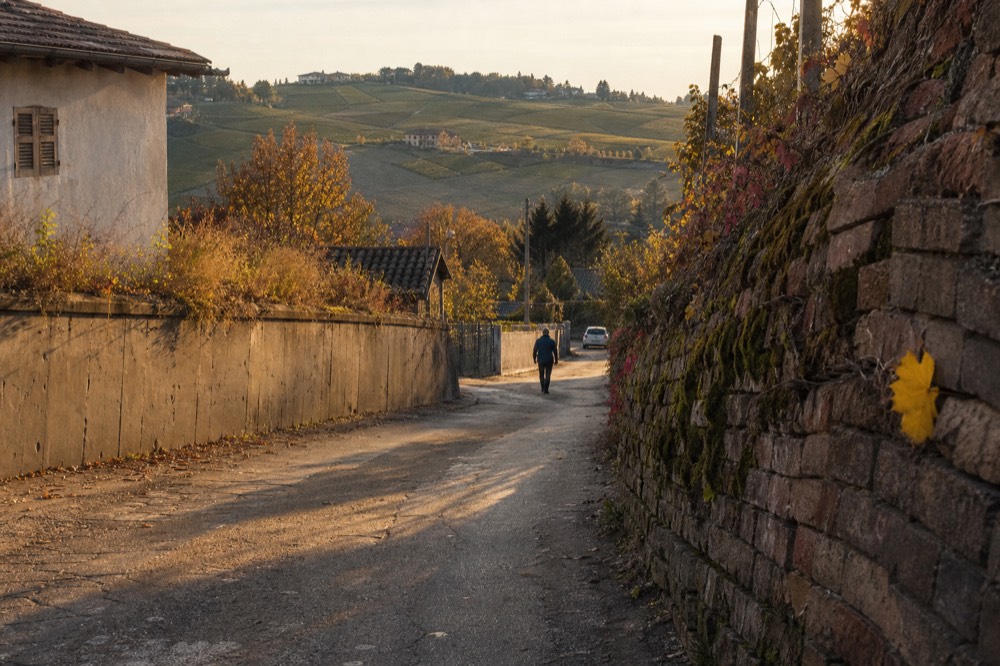
Most Barolo riding is on narrow, quiet, asphalt country roads between vineyard rows, with short stretches of unpaved strade bianche on the ridges and inside the bigger estates. There is no verified dedicated cycle path in the zone. The funded 32.5 km Ciclovia delle Colline Unesco between Alba and Canelli is not yet built, so today every Barolo route is a road route, shared with tractors and the occasional delivery van.
That last point deserves emphasis because marketing copy blurs it. The Comune di Alba confirmed in November 2025 that the Alba to Canelli cycle route received a 10 million euro regional grant, with works due to be assigned by September 2026. It is a funded project, not a path you can ride today, and any listing that implies otherwise is describing a future. Meanwhile the roads you will actually use are old farm lanes, wide enough for one car, generally well surfaced, and busiest during the vendemmia, the September and October harvest, when tractors move grapes continuously.
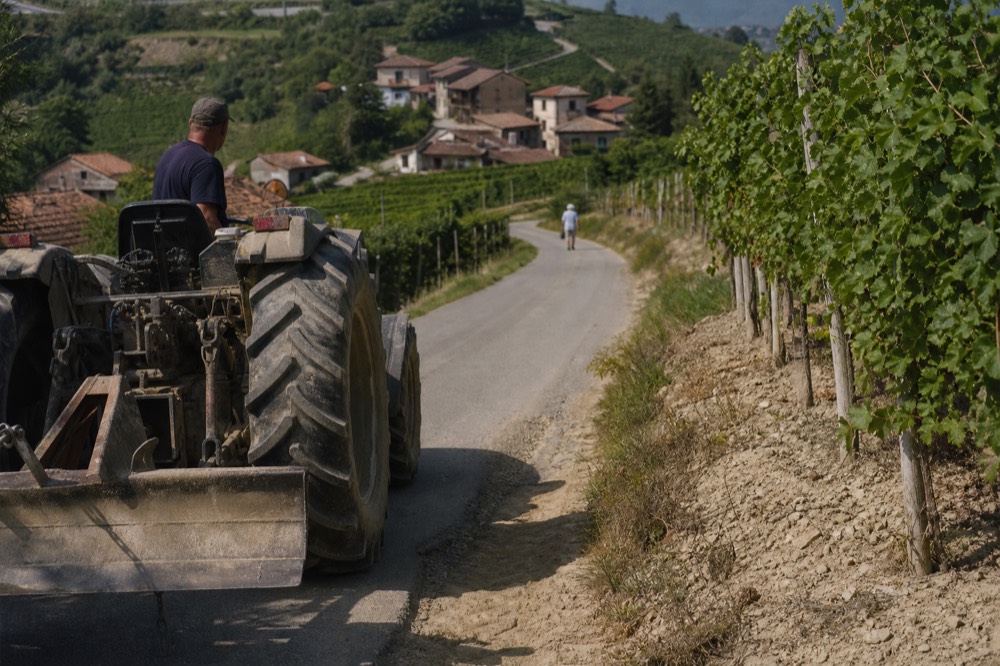
Surfaces, honestly summarised: asphalt for the overwhelming share of any Barolo route; compacted gravel on some ridge links and estate driveways, which an e-bike with city tyres handles without trouble; and, in the villages themselves, a mix of cobblestone and paving that rewards slower speeds. Gravel-specific statistics for named Langhe routes are not verified anywhere, so this site does not publish any. If a tour describes "dirt road" sections, as the private Langhe del Barolo tour explicitly does, expect those estate lanes rather than backcountry trails.
For riding the same hills without a guide at all, the planning detail is in self-guided bike tours in the Langhe.
Riding To La Morra And The Brunate Viewpoint
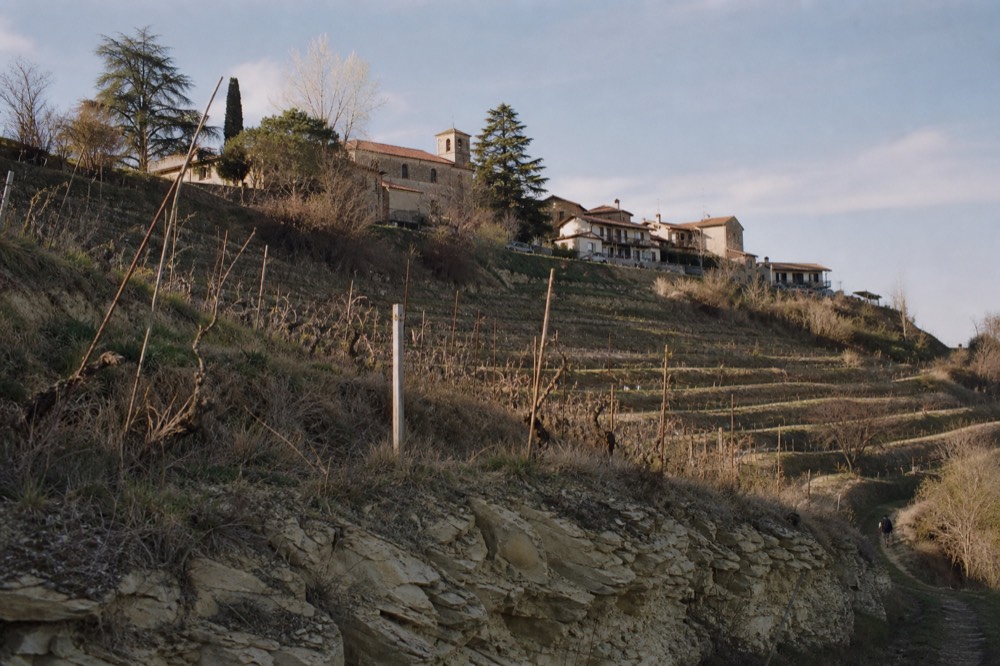
La Morra is the high altar of a Barolo route: its centre stands at 508 m, roughly 320 to 370 m above the valley floor, and the one-way climb from Alba gains about 329 m over 15.8 km. Above the village, the Brunate hill holds the Cappella del Barolo, the striped chapel in the vineyards that appears in nearly every photograph of the Langhe.
The climb itself is steady rather than severe, which is why no gradient figure is printed here: none is verified from a primary source, and this site uses height gained instead. What is verifiable is the reward. From the La Morra belvedere you look across the whole Barolo zone at once, which is precisely the panorama that sold the area to UNESCO's assessors in 2014. Brunate is also one of the zone's famous vineyard names, so the chapel you are photographing stands in a cru, not just a viewpoint.
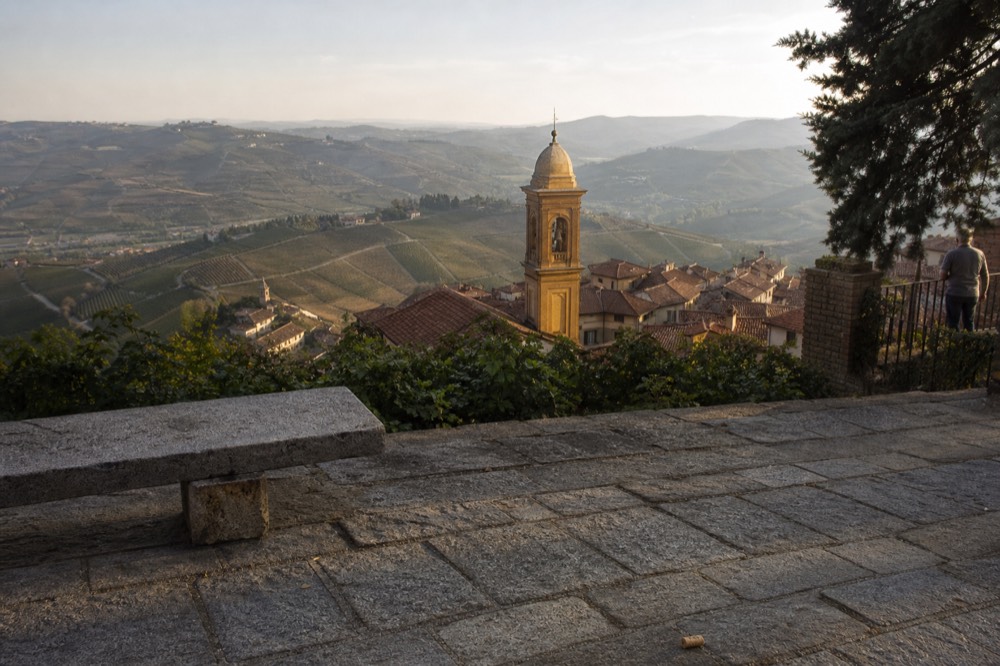
A route built around the western flank, Grinzane Cavour then La Morra then down into Barolo, is the most efficient way to collect both the castle and the belvedere in one morning, about 22 km of riding from Alba with the day's main climb done before the first tasting. One planning caution: check current status of the Cappella del Barolo with the Barolo and Castles Foundation before promising it to a group, as its opening situation is not reliably published season to season.
For riders who want that western ridge experience at a slow pace with the villages named and explained, Langhe Slow runs about 5.5 hours between Serralunga d'Alba and Barolo through the UNESCO heritage sites, from $157 per person. It is a new listing without reviews yet, so judge it on the route, which is exactly the point of this article.
What Rules Apply On The Road During A Barolo Ride?
Italy has no helmet law for cyclists of any age, but three rules do apply on Barolo roads: a reflective vest is legally required outside built-up areas from half an hour after sunset to half an hour before sunrise, and in tunnels at any hour; a bell is required equipment on every bicycle; and riders must proceed single file outside built-up areas, with motor vehicles obliged to pass at 1.5 m where road conditions permit.
The Langhe is almost entirely outside built-up areas, which is what makes the vest rule a real trap rather than trivia. An October ride finishing near dusk crosses the legal threshold without anyone noticing. Fines for breaching the cyclist articles run from 26 to 102 euro. The 1.5 m passing distance was written into the Codice della Strada by the 2024 reform, and its conditional wording, "where road conditions permit", matters on roads with blind vineyard walls on both sides.
For pedal-assist bikes, the law is clear: a compliant e-bike is a bicycle, limited to 250 W of nominal power with assistance cutting out at 25 km/h, needing no licence, plate or insurance. A 45 km/h speed pedelec is not a bicycle in Italian law. Tour fleets in this region are standard pedelecs, so this distinction is one for buyers of a private bike rather than tour customers. The full rules are covered in e-bike tours in Italy and why the Langhe suits pedal assist.
Guided, Self-Guided Or Rental: Which Format Fits Which Route?
Guided e-bike tours suit the Barolo ridge roads, because the guide carries the route knowledge and the tasting bookings and the e-bike flattens the 300 to 500 m climbs. Self-guided rental suits confident riders who want the Barbaresco loop or a custom line. The gap in price is real: rental formats in the Langa del Barolo start from $52 per person for a day, guided scenic tours from $186, private guided from $118.
The arithmetic of that spread is worth spelling out. The from-$52 rental day gives you the bike and the hills but no cellar doors opened for you; tasting fees in the Alba area are listed from around 25 to 50 euro per person for a visit with tasting, so a rental day plus two cellars lands close to the guided price anyway. The guided formats bundle the route, the guide and one tasting; the private format gives you the route and guide and leaves lunch to you.
| Format | Typical length | From price | Best route fit |
|---|---|---|---|
| E-bike rental with food and wine stops | ~1 day | $52 pp | Barbaresco loop, custom western flank |
| Private guided e-bike (asphalt and dirt) | 6–7 hours | $118 pp | Full Barolo villages loop |
| Langhe Slow guided e-bike | ~5.5 hours | $157 pp | Serralunga to Barolo, UNESCO sites |
| Guided scenic e-bike with tasting | ~5 hours | $186 pp | Classic circuit with cellar stop |
| Picnic vineyard tour | ~6 hours | $93 pp | Gentler vineyard circuit |
The classic choice for a first Barolo day remains the guided scenic e-bike tour: roughly five hours, from $186 per person, with the wine tasting included, and it has a 4.0 rating from 5 reviews so far. It covers exactly the kind of ridge circuit described above, which is why it is this article's related tour, and booking questions, dates and the cancellation policy are on the operator's live listing.
One seasonal note to close the planning: September is the standout month for riding this region, with a typical average high of 23.6 degrees at Alba against July's 29.2, and it coincides with the harvest, when Nebbiolo for Barolo comes in from late September with the fruit usually the last off the hill in early October. The timing detail is in the best time to visit Piedmont.
If one of these formats fits your plan, check availability and current dates on the live listings before committing to a route of your own.
The short answers: the full Barolo villages loop from Alba is about 68 km with roughly 877 m of ascent; the zone covers 11 communes; there is no dedicated cycle path in the zone today; helmets are legal but not required; and September is the strongest riding month. Each question below unpacks one of these in full.
Common Questions About Barolo Bike Tour Routes
How far is the full Barolo villages bike loop?
Computed from the real road network, the loop from Alba linking Grinzane Cavour, La Morra, Barolo, Novello, Monforte d'Alba, Serralunga d'Alba and Castiglione Falletto is about 68 km with roughly 877 m of ascent. Most guided tours ride a 15 to 20 km slice of it rather than the whole circuit.
Which villages does a Barolo bike tour pass through?
The Barolo DOCG zone covers 11 communes: Barolo, Castiglione Falletto and Serralunga d'Alba entirely, plus La Morra, Monforte d'Alba, Novello, Verduno, Grinzane Cavour, Diano d'Alba, Cherasco and Roddi in part. A typical tour touches three to five, usually on the ridge roads between Barolo, La Morra and Serralunga d'Alba.
Is a Barolo bike tour hilly?
Yes. The valley floor at Alba sits at 139 m and La Morra's centre stands at 508 m, so ridge rides gain 150 to 350 m per climb, roughly 877 m over the full loop. That is exactly why most commercial Barolo tours use e-bikes, which turn the same route into a comfortable half or full day.
Can I ride a dedicated cycle path between the Barolo villages?
No. There is no verified cycle path in the zone today. The 32.5 km Ciclovia delle Colline Unesco between Alba and Canelli is funded, with a 10 million euro regional grant, but it is not built, so all current Barolo routes use ordinary quiet roads shared with cars and tractors.
Do I need a helmet on a bike tour in Barolo?
Italian law does not require a helmet for cyclists of any age, though operators commonly provide and recommend them. Three rules do apply: a reflective vest outside built-up areas after dark and in tunnels, a bell on the bike, and single file riding outside built-up areas.
Is September a good month for a Barolo bike tour?
September is the strongest month on typical climate data, with an average high around 23.6 degrees at Alba and the harvest underway, Nebbiolo coming in from late September. July and August are hotter, with average highs near 29, and November is the wettest month at around 115 mm.